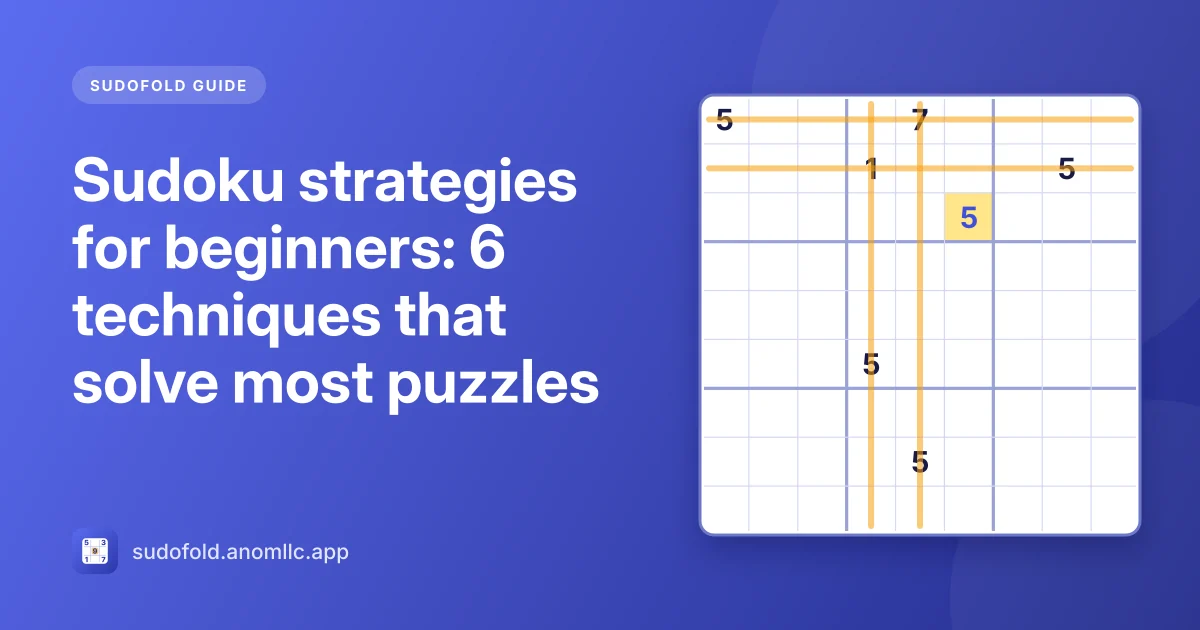
Most sudoku puzzles, up to Hard, can be solved with six techniques: hidden singles, naked singles, counting, naked pairs, hidden pairs and pointing pairs. Learn them in that order. The first two place digits directly; the last three use notes to rule digits out until a single appears.
1. Hidden single (cross-hatching)
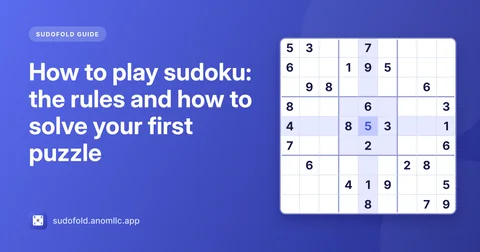
Choose a digit and a box. Draw imaginary lines through every row and column that already holds that digit. If only one cell in the box survives, the digit goes there.
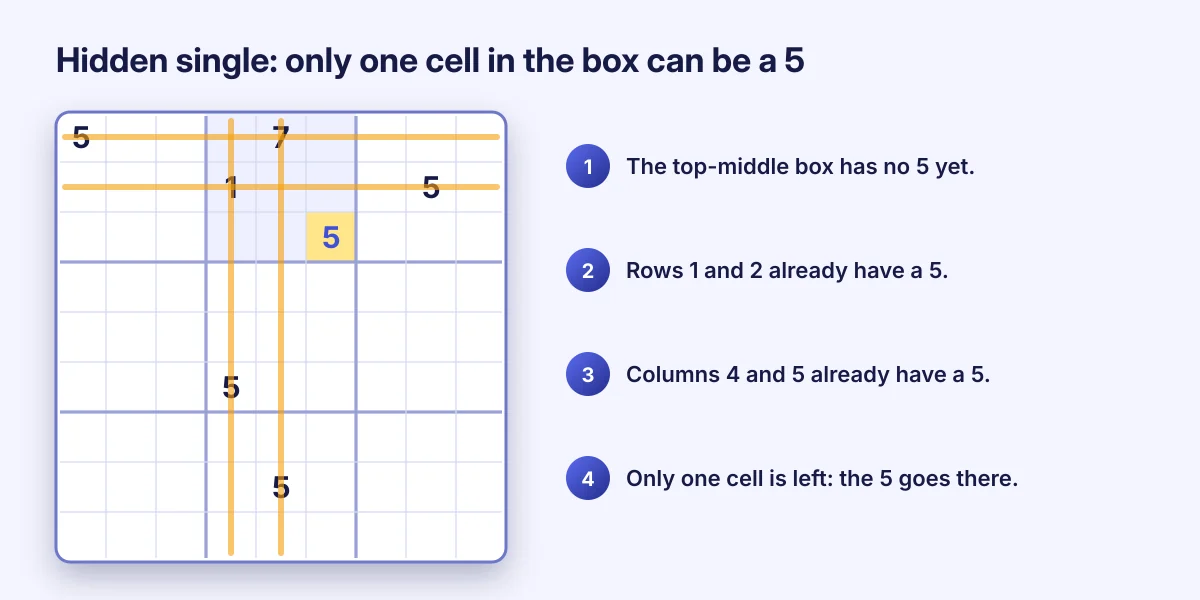
Hidden singles work in rows and columns too: if a digit can go in only one cell of a row, it goes there, even if that cell could hold other digits.
2. Naked single
Pick one cell and look at its row, column and box together. If eight different digits already appear among them, the cell must be the ninth. Naked singles are easiest to spot in busy parts of the grid and near the end of a puzzle.
3. Counting what's left
When a row, column or box has only two or three empty cells, list the missing digits and check each against the crossing columns or rows. Often only one arrangement fits. In Sudofold, the small number under each digit button shows how many of that digit are still to place, which tells you where to look: a digit with 1 left has exactly one cell waiting for it.
4. Naked pair
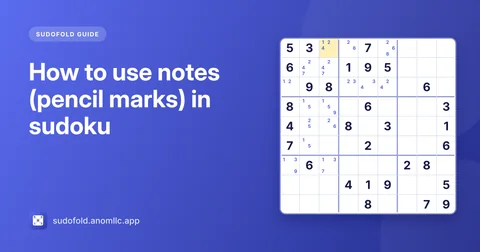
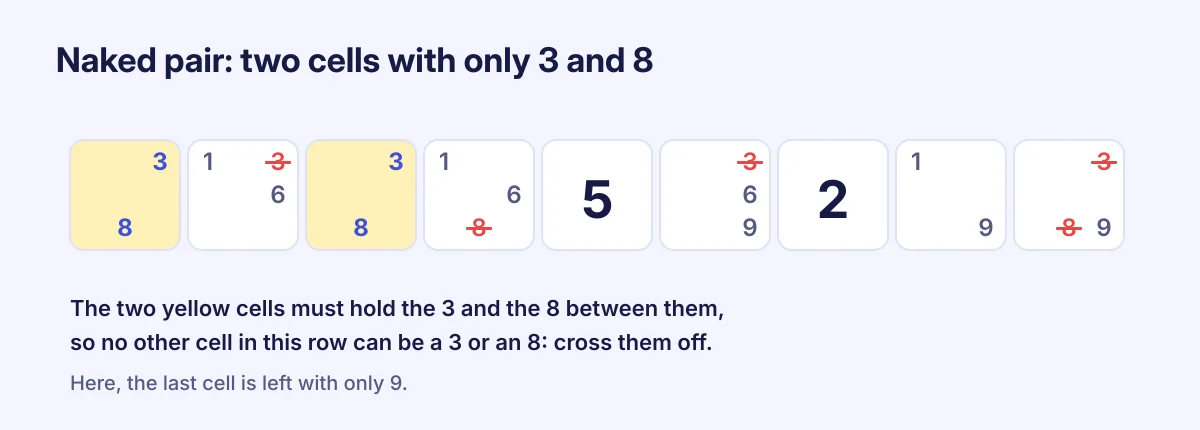
Once you have notes, look for two cells in the same row, column or box that both have exactly the same two candidates, for example {3, 8} and {3, 8}. Between them, those two cells will take the 3 and the 8, so no other cell in that row, column or box can be a 3 or an 8. Remove those candidates from the other cells. The same idea works with three cells sharing three candidates (a naked triple).
5. Hidden pair
The mirror image of a naked pair: two digits that can only go in the same two cells of a row, column or box. Those cells must hold those two digits, so you can delete every other candidate from them. Hidden pairs are harder to see, because the two cells usually have extra notes hiding the pattern.
6. Pointing pair
Inside a box, if all the cells that could hold a digit lie in one row (or one column), the digit must be in that row within this box. So it can't be anywhere else in that row, outside the box. Cross it off there. This often unlocks a hidden single in the next box along.
A good order to work in
- Scan every digit for hidden singles, 1 to 9, box by box.
- Fill naked singles where the grid is crowded.
- When both run dry, write notes in every empty cell.
- Look for pairs and pointing pairs, cross off what they rule out, and go back to step 1.
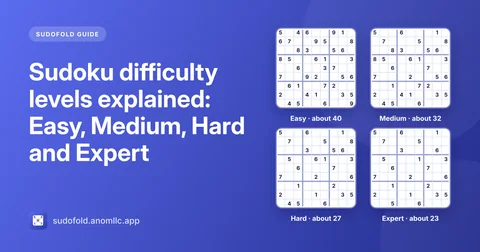
Sudofold's levels follow this ladder: Easy and Medium can always be solved with singles alone, while Hard and Expert need the note-based techniques. Sudoku difficulty levels explained has the details, and how to use pencil marks shows how to keep notes tidy enough to spot pairs.